The Project Management Lifecycle is the spine of successful projects and directs every step in the lifecycle of the project, including the planning and closure. Being efficient in it can save money as well as develop important skills needed to succeed in one’s career.
Project Management Life Cycle: Why It’s the Key to Successful Project Delivery
Project management is merely the process of proper planning and execution of a project. When a project is initiated, the client/stakeholder has an objective in mind, and the project manager develops a crystallized plan, determining who will do what, when, and with what resources. The key factor here is the project management triangle: time, cost, and scope. When these three are in balance, the project is moving with ease and can deliver reports.
Therefore, it is the Key to successful project delivery.
- Clear Direction: Project management provides a map in order to enable everyone to be on the same track of what has to be done and when. In the absence of such clarity, our projects tend to be late or sometimes go off track.
- More Efficient Usage of Resources: It makes people, finances, and tools be used wisely without wastage and minimizes expenses.
- Risk Control: Effective project management helps anticipate potential problems and provides a contingency plan to address them early.
- Better Quality Outcome: The outcome of tasks is more likely to meet and even surpass the expectations of stakeholders due to proper planning and monitoring of the tasks.
- On-Time Delivery: With the emphasis on the time, cost, and scope of the project, it will be more probable to complete a project on time without any end-time rush.
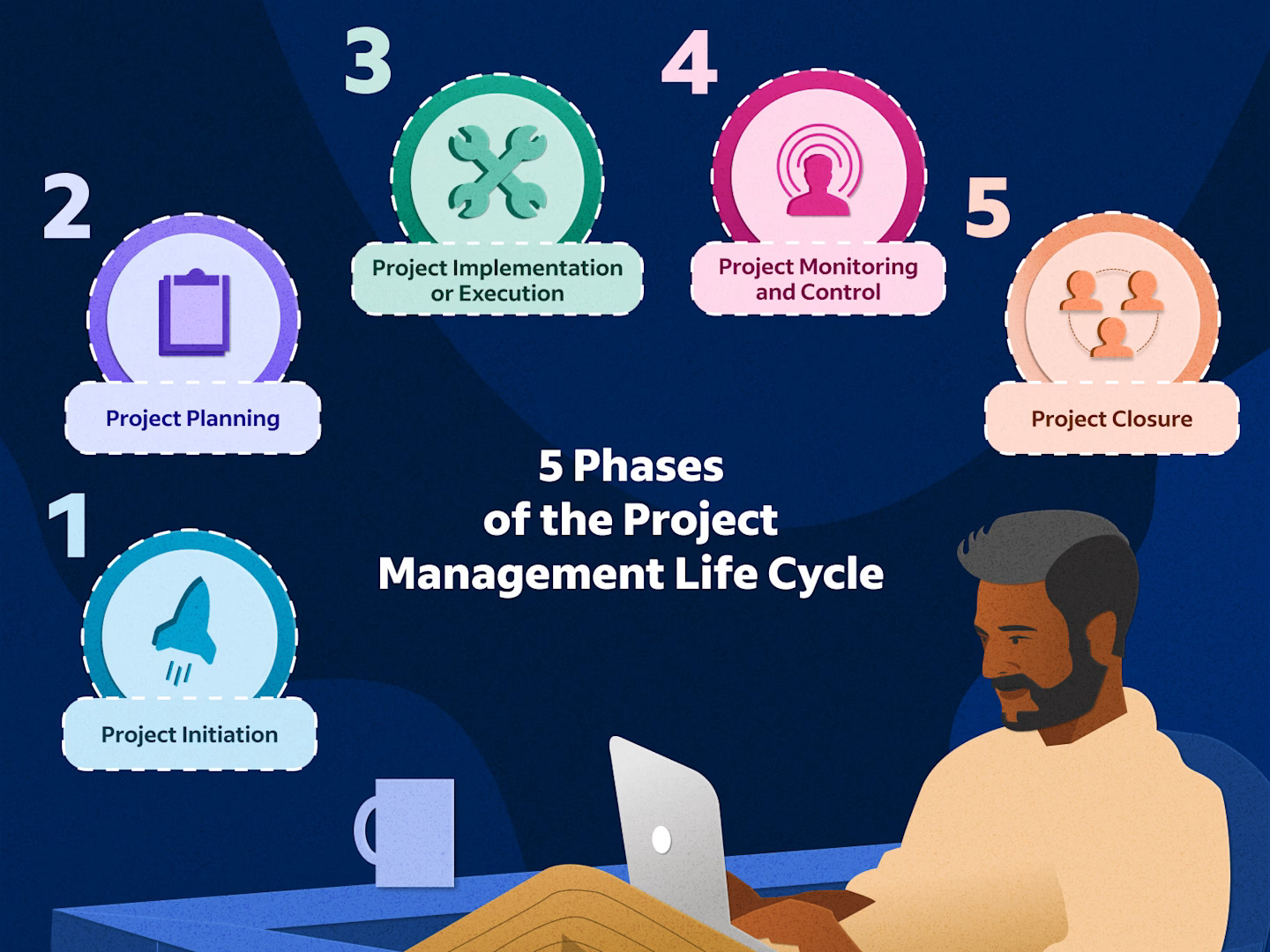
5 Stages of Project Management Lifecycle
- Project Initiation: This is the point of origin of everything. Here, ideas were planned and evaluated to determine their feasibility. We set the objectives, we will establish the stakeholders, and we will ensure that the project is aligned with the greater goals. You can think of it as the preparatory stage; you cannot start construction of a house without enquiring about the strength of the ground, right?
- Planning: The next step is to draw a detailed roadmap after the project is approved. In this step, work is planned, a schedule is determined, resources are assigned, and risk analysis is performed. This step is crucial in the sense that all will understand what is expected of them and how the journey is going to be. It is just like drafting a map before a road trip; you will always have a direction to where you are going.
- Execution: This is where actions are put into application. The team collaborates to achieve the goals and attain the outcomes. Here, collaboration, communication, and teamwork play a crucial role. There are always small changes on the way, but the vision is always to go ahead.
- Monitoring & Control: Planning is not sufficient; you need to monitor the progress. During this stage, we monitor the status of the project with respect to the initial plan. In case of something getting off track, corrections are promptly undertaken. It is like driving a car; when you go out of the lane, you automatically steer to get back into the road.
- Closure of Project: At this stage, the project is closed after the projects are prepared and signed off. In this stage, we write down what we have learnt as well as set the team free from formalities. It is not only a matter of completion and seeing how it got done, but also an opportunity to analyze what was successful and what can be done better next time.
Important Tools and Methodologies.
Project managers use many tools and methodologies in order to sail through each of these phases.
Popular Tools:
Jira: Jira is known to be flexible and powerful in agile software development.
Trello: This is a simple visual tool, and it manages tasks in a card-based form.
MS Project: A conventional, high-level solution to massive, institutionalized projects.
Asana: A managed app that allows overseeing and organizing work that is shared between teams.
Monday.com: It is a highly customisable platform that can be tailored to different projects.
Smartsheet: This is a combination of the comfort of a spreadsheet and the strength of a project management system.
Key Methodologies:
Agile: An iterative method that emphasizes flexibility and ongoing improvement.
Scrum: Scrum is an Agile framework that applies short cycles (sprints) to deliver value.
Waterfall model: It is a traditional and linear style wherein one stage ends and the next starts.
PRINCE2: A process-oriented approach that offers a systematic framework of project governance.
How project management impacts your business
Project management is not something that only large companies with numerous teams utilize; this applies to any type of business, big or small. In essence, it is about ensuring that your objectives are met without wasting either time, money, or other resources.
For example, let’s suppose you have a bakery and you receive a huge order of 500 cupcakes. A lack of planning may slow you down in running out of ingredients, meeting the deadline, or satisfying the customer. When it comes to project management, however, you will divide the work into convenient stages, make acquisitions on time, delegate your tasks to individual employees, and monitor the course, making sure that the order will be perfect and complete on time.
Your Career to a High-Paying Job with Viewsoft Academy’s Fundamentals of Project Management Certification Course
Earning a certification in project management can make a huge difference in terms of earnings.
Learning project management is one thing; mastering it is another. We have developed our all-inclusive certification programs with ambitious aspiring US students and IT professionals such as yourself in mind. The curriculum is designed based on real-life situations and with practical application at the core, you will have the skills required to coordinate projects with ease.
Frequently Asked Questions about Project Management Lifecycle
Question 1. How does the project management lifecycle actually save time and money?
Answer: It is useful because it saves time and money by providing structure to projects. Instead of doing the same thing repeatedly and losing the effort put into it, lifecycle keeps all tasks planned, resources utilised sensibly, and risks minimised. This causes a smoother run and cost savings. Knowing it enables you to get projects done faster and better.
Question 2. What’s the biggest mistake people make with the project management lifecycle?
Answer: The most common pitfall is not planning but going into execution. Lack of goals, roles, and deadlines means that the projects become tangled. The lifecycle circumvents this by taking the phases one step at a time. You can learn how to avoid these expensive mistakes with the correct instruction, such as what View Softnic provides in its training.
Question 3. Why is Project Management considered a must-have skill in today’s corporate world?
Answer: The current companies are interested in applicants who can manage projects effectively, reduce expenses, and meet deadlines. Project management develops you as a person, organized, strategic, and result-driven. It is a skill that can place you in all kinds of industries. Mastering it would also mean that you come across as a leader who contributes substantially to businesses.
Question 4. Why should I learn the Project Management Lifecycle instead of just focusing on tools like Jira or Trello?
Answer: Such tools as Jira or Trello will only help you to monitor the tasks, but they just won’t teach you to lead projects. The lifecycle provides an overview of how to structure and control risk to achieve success. As soon as you learn how to operate it, any other tool will be much easier and more effective in practical use.
Question 5. How does the planning phase of the lifecycle prevent project failures later on?
Answer: Planning establishes the framework by setting out objectives, schedules, work registers, and resources. It also eliminates risks at the earlier stage of identification in order to be in a position to provide solutions. A good plan makes the way of implementation effortless and the risk of failure minimized. This is why the way of proper planning can be regarded as the core of successful project management.
Question 6. What is the average salary of a project manager in the US?
Answer: The most common compensation package of a project manager in the US is around $108,000, with the average salary being $96,380, and this is subject to change, generally depending on the individual area of employment. These amounts may differ dramatically with regard to industry, location, experience, and certifications. Such certification as a PMP (Project Management Professional), on average, can raise your salary by an additional $25,000.
Question 7. What is the time span of the lifecycle mastery?
Answer: The principles of the project management lifecycle can be acquired within a rather limited time, but they can only be truly mastered through experience. Our organized training systems covering 48 practical sessions in six months equip you with the necessary and prerequisite knowledge and practical skills to ensure that you have a strong foundation before you embark on employment.
Question 8. Am I supposed to have any prior experience to learn Project Management?
Answer: No, you do not require experience before you begin to learn project management. Our programs will support not only the beginner but also the experienced professional and provide a straightforward road to certification and career progression. It all depends on the right training and interest in leading projects.