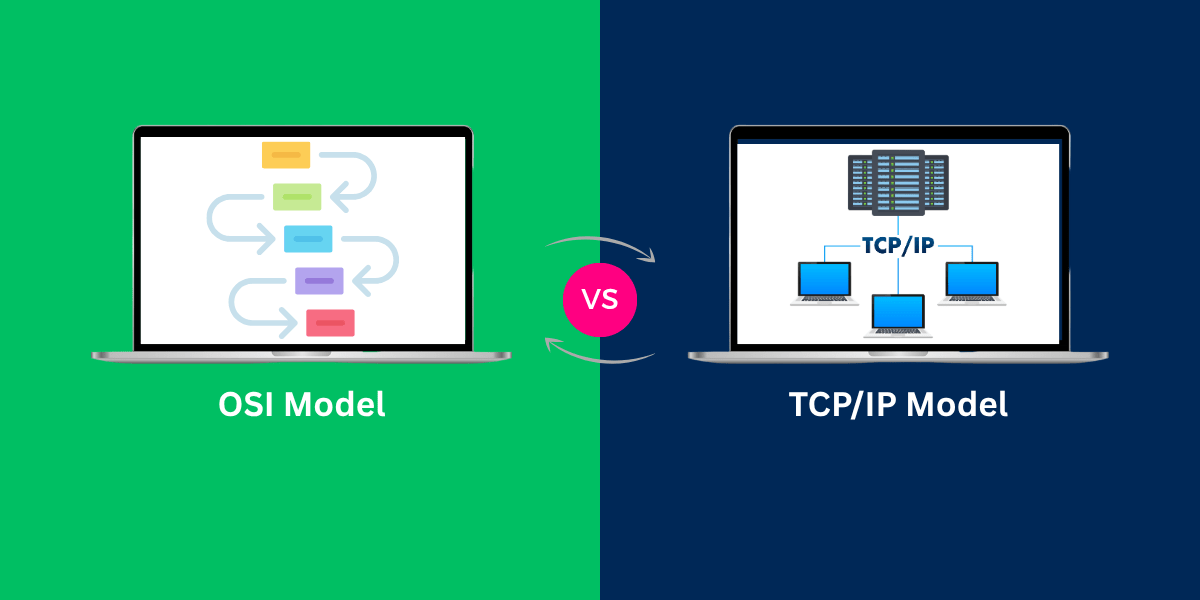
In today’s connected world, the Internet and cloud computing rely on networking protocols, which makes network models crucial in modern IT. The OSI Model and TCP/IP Model are two foundational frameworks with unique roles in networking. While the OSI model is invaluable for understanding and troubleshooting networks, the TCP/IP model drives real world communication. In this blog, ViewSoft Academy with provide you with everything you need to know about the OSI Model vs TCP/IP Model and which is More Relevant Today?
Understanding the OSI Model
The OSI model was created by the International Organization for Standardization (ISO) in the 1980s as a conceptual framework to standardize networking communications. The main objective of the OSI model is to take an elaborate process of data transmission and break it down into seven distinct layers. Each layer has its own function and communicates with the layers above and below it, which helps analyze and troubleshoot networks.
The seven layers of the OSI model:
- Physical Layer – Hardware, cables, switches, and the properties of data that are physically being transferred.
- Data Link Layer – Node-to-node data transfer and establishing error detection.
- Network Layer – Addressing, routing, and forwarding packets.
- Transport Layer – Reliable data transfer with error correction and flow control.
- Session Layer – Sessions, connections, and dialogues between devices.
- Presentation Layer – Data formatting, encryption, and compression for intended applications.
- Application Layer – Network services to end applications.
Understanding the TCP/IP Model
The TCP/IP model was developed by the U.S. Department of Defense and is a practical model for real-world networking, namely the Internet. The TCP/IP model is different from the OSI model in that it is implementation-oriented and is a model to help guide the behavior of protocols and how two devices can communicate properly across a network.
There are 4 layers to TCP/IP, including:
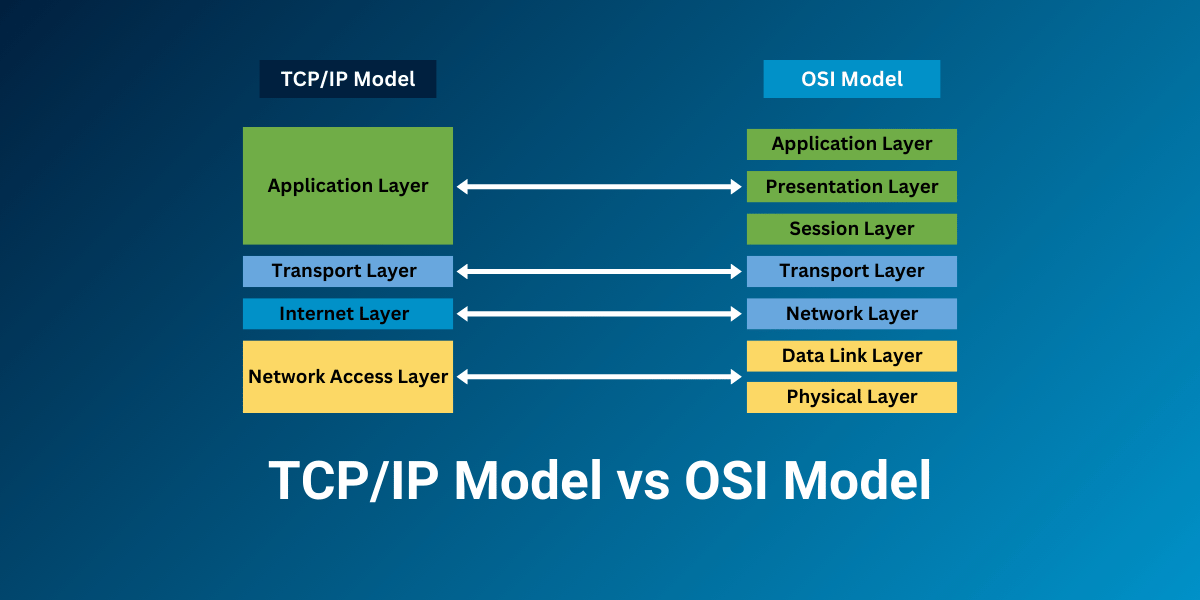
Network Access Layer – The Network Access Layer functions like the Physical and Data Link layers of the OSI model since it is responsible for hardware addresses and communication on a local network.
Internet Layer – The Internet Layer is comparable to the Network layer of the OSI model, using Internet Protocol (IP) for logical addressing and routing.
Transport Layer – The Transport Layer is responsible for end-to-end communication and ensures communication is reliable to the application layer, generally utilizing TCP or UDP.
Application Layer – The Application Layer expresses the functions of the Application, Presentation, and Session layers of the OSI Model by including services like HTTP, FTP, and SMTP.
What are the Key Differences Between the OSI Model & TCP/IP Model?
There are some key differences between the OSI Model and TCP/IP Model, including:
| Feature | OSI Model | TCP/IP Model |
| Layers | 7 Layers | 4 Layers |
| Purpose | Theoretical reference | Practical Internet model |
| Layering | Vertical, distinct layers | Simplified, combines some layers |
| Session & Presentation | Separate layers | Combined into the Application layer |
| Protocol | Independent | Dependent |
| Network Layer | Connection-oriented & connectionless | Connectionless only |
| Error Handling | Across multiple layers | Handled at the Transport layer |
Which Model is More Relevant Today? – OSI Model or TCP/IP Model
The TCP/IP model has more practical application and relevance to day-to-day use of the internet, while the OSI model serves a useful purpose as a more detailed conceptual model for learning about networking and troubleshooting. The TCP/IP model forms the basis of the Internet, so it is the model that is used in practice. The OSI model has granular seven-layered stacks, which makes it more useful for teaching purposes and understanding the concepts of networking, troubleshooting, and comparing protocols.
TCP/IP Model
- Relevance: The model that the internet is constructed upon is therefore more practical and what is widely used.
- Structure: A four-layered model that is less granular and aggregates many functions and protocols into a single layer.
- Application: Directly corresponds to the actual protocols of today, for example, TCP and UDP.
OSI Model
- Relevance: An excellent educational tool and theoretical model for understanding concepts of networking and for troubleshooting issues.
- Structure: A seven-layered model that is more detailed and segmented, allowing for easier isolation of issues.
- Application: A model that is a standard reference to talk and learn about network communication, but not one that is used for actual implementation.
Why Both Models Matter for IT Students
Learning both models will give IT learners:
Troubleshooting Skills – Knowledge of the OSI layers allows students to quickly find the network problem.
Practical Knowledge – TCP/IP demonstrates the protocols used on the Internet as they really are.
Certification Ready – Both models are covered in several certifications such as CompTIA Network+, Cisco CCNA, and ITIL.
Conceptual Understanding – Layered models help students understand the flow of data, which is necessary for designing and securing data networks.
How ViewSoft Academy Helps You Master Networking Fundamentals
At ViewSoft Academy, we recognize that networking concepts can seem abstract until they are placed in a contextual, real-world application. That is why our hands-on IT programs provide learners with:
- Practical labs showing OSI and TCP/IP data communication in action and in context
- Exercises related to configuring networks, routing, and troubleshooting
- Real-world projects that depict the concepts using tools such as Wireshark
- Guidance for preparing for the CompTIA Network+, CCNA, and other networking certification exams.
Conclusion
To sum up everything that has been stated so far, the above given information on the topic “OSI Model vs TCP/IP Model – Which is More Relevant Today?” states that the TCP/IP Model is more relevant today as it is used for real world internet communication, whereas OSI model is also crucial for learning and troubleshooting. If you want to learn more about the networking protocols and network models, feel free to visit the ViewSoft Academy website.
FAQs About OSI Model vs TCP/IP Model
Question 1. What is the key difference between the OSI and TCP/IP models?
Answer. The key difference between the OSI and TCP/IP models is that the OSI model is a conceptual and seven-layer framework, whereas TCP/IP is a practical four-layer model and is used for real world internet communication.
Question 2. Are the OSI and TCP/IP models compatible?
Answer. Yes, for conceptual understanding, the TCP/IP model can be mapped to the OSI layers but their structures are different.
Question 3. Which model should I focus on if I want practical networking skills?
Answer. If you want practical networking skills, you should focus on TCP/IP but understanding OSI can help in troubleshooting, designing and conceptualizing networks.
Question 4. Which model is more relevant in today’s networking?
Answer. For real world networking, TCP/IP is more relevant because it works as the backbone of the internet, whereas OSI is primarily used for learning and troubleshooting.