Understanding how data travels across a network is a fundamental skill for anyone who want to start their IT journey. Networking Models like OSI and TCP/IP helps to understand how exactly is devices exchange data. In this blog, ViewSoft Academy will provide you with everything you need to know about the OSI Model and TCP/IP Model Explained with Diagrams to help you visualize each layer and the key differences between them.
What Are Networking Models?
Networking Models are industry-agreed-upon means to represent Networking Protocols. They are models that define how Data is transmitted and received over a Network; the protocols contained within these Models serve as a guideline for developers to develop Applications that communicate across Networks.
- Models give Developers the guidelines and standards necessary for Developing Applications that communicate between Computers; these Models are like the blueprints used in building a Home.
- All Networking Models split Network Communication into several Layers. Each Layer represents a Different Function; it focuses on Taking Data from its Original Source to its Final Destination.
- The two most important Networking Models are the OSI Model (a seven-layer model) and the TCP/IP Model (a four-layer model).
- By having a Standard Way to represent and define how Networking Protocols communicate and Interoperate with each other, it allows different Networking Components to Work together and function properly.
Overview of the OSI Model
The OSI Model is a conceptual tool that defines networking protocols by splitting them into seven distinct levels (layers). The functionality of each of these seven layers ranges from the physical delivery of binary digits in the lowest layer through to the use of User Applications at the highest layer to process data and return it as usable Outputs. This method of organizing networking theories enables easier identification, design, and debugging of all Networking Activities by providing a logical separation of each of the different components that make up the communications process.

Definitions of each of the Seven Layers of the OSI Model
7th Layer – Application Layer: An interface between the user application and the Network service providers (Web Browsers & E-Mail Clients).
6th Layer – Presentation Layer: Handles data translation, formatting, encryption and compression to ensure data is in a format the application layer can use.
5th Layer – Session Layer: Establishes, maintains and terminates established sessions between Users.
4th Layer – Transport Layer: Provides User to User data transport and the ability to segment and control the rate of flow of Data through the Transport Layer using TCP and UDP.
3rd Layer – Network Layer: Handles the Routing and Addressing of data across multiple Networks.
2nd Layer – Data Link Layer: Provides point to point Data Transfer and Error Check on Physical Addressing with the use of MAC Addresses.
1st Layer – Physical Layer: Transmits the Raw Binary Digits of Data via a Physical Medium.
Overview of the TCP/IP Model
The TCP/IP Model is made up of four layers that provide a way for data to be communicated over any type of network such as the Internet. Each layer provides a function to allow communication of data between computers. For example, when data is sent from one computer to another, it is broken down into packets and assigned an address so it can be routed to its destination. TCP (Transmission Control Protocol) is responsible for providing reliability for the packets being sent between computers, while IP (Internet Protocol) is responsible for routing the packets.

The TCP/IP Model is made up of 4 layers:
1st Layer – Link Layer (also known as the Physical Layer) refers to the physical wires and cables used physically connect computers within a local area network.
2nd Layer – Internet Layer uses the Internet Protocol (IP) to assign logical addresses to the packets of information as well as to route the packets.
3rd Layer – Transport Layer is where reliability comes into play; this layer is responsible for ensuring that all data sent from a computer reaches its destination in full and intact. TCP (Transmission Control Protocol) is used to provide reliability, while UDP (User Datagram Protocol) is a more efficient but less reliable means to transmit data.
4th Layer – Application Layer (or user-facing layer) contains protocols used to send information from one computer to another for specific applications. Examples of these protocols are: HTTP (Hypertext Transfer Protocol for web browsing), SMTP (Simple Mail Transfer Protocol for email), and FTP (File Transfer Protocol for file transfer).
Want to know more about the layers of OSI and TCP/IP models? Read our blog on the layers of OSI and TCP/IP model.
What are the Key Differences Between the OSI Model and TCP/IP Model?
Here are some of the key differences between the OSI model and TCP/IP model, including:
| Feature | OSI Model | TCP/IP Model |
| Nature | Theoretical and conceptual reference model | Practical, implementation oriented model |
| Number of Layers | 7 layers | 4 or 5 layers |
| Layering Structure | Strict and clearly separated layers | Less rigid, more flexible architecture |
| Purpose | Provides a standardized framework to understand network communication | Defines real world protocols that run the Internet |
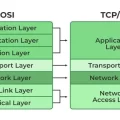
| Application Layer Design | Application, Presentation and Session layers are separate | These three layers are combined into a single Application layer |
| Network Interface Handling | Physical and Data Link layers are distinct | Merges Physical + Data Link into the Network Access layer |
| Protocol Dependency | Protocol independent | Protocol dependent |
| Implementation | Not used directly in practical networking | Fully implemented and used across modern networks & the Internet |
Diagram: OSI Model vs TCP/IP Model Mapping

Common Protocols and Where They Fit (OSI + TCP/IP)
Some of the common protocols and where they fit include:
| OSI Layer | TCP/IP Layer | Common Protocols |
| 7. Application | 4. Application | HTTP, HTTPS, FTP, SMTP, DNS, SNMP, SSH |
| 6. Presentation | 4. Application | (Functions integrated into Application layer) |
| 5. Session | 4. Application | (Functions integrated into Application layer) |
| 4. Transport | 3. Transport | TCP, UDP |
| 3. Network | 2. Internet | IP, ICMP, ARP, IGMP |
| 2. Data Link | 1. Network Access | Ethernet, PPP, IEEE 802.2 |
| 1. Physical | 1. Network Access | Ethernet, Token Ring, RS-232 |
Conclusion
To sum up everything that has been stated so far, the above given information on the topic “OSI Model and TCP/IP Model Explained with Diagrams” states that understanding the OSI Model and TCP/IP Model is crucial for mastering networking fundamentals. If you want to start your career in IT networking, contact ViewSoft Academy today for hands on IT training programs. Visit Our Website Today!
Frequently Asked Questions About the OSI Model and the TCP/IP Model
Question 1. What is the difference between the OSI Model and the TCP/IP Model?
Answer. The key difference between the OSI Model and the TCP/IP Model is that the OSI model is a conceptual, 7 layer reference model, while the TCP/IP model is a practical, 4 layer model based on the protocols that run the internet.
Question 2. Which model is used in real-world networking OSI or TCP/IP?
Answer. The TCP/IP model is used in real-world networking. It is a practical framework that makes the internet function whereas the OSI model is more conceptual.
Question 3. What are some common protocols in each OSI and TCP/IP layer?
Answer. Some common protocols in each OSI and TCP/IP layer include TCP and UDP at the Transport layer, IP, ARP and ICMP at the Network layer, Ethernet and PPP at the Data Link layer and protocols.
Question 4. Are the OSI and TCP/IP models included in IT certification exams?
Answer. Yes, OSI and TCP/IP models are fundamental topics in many IT certification exams though exams.