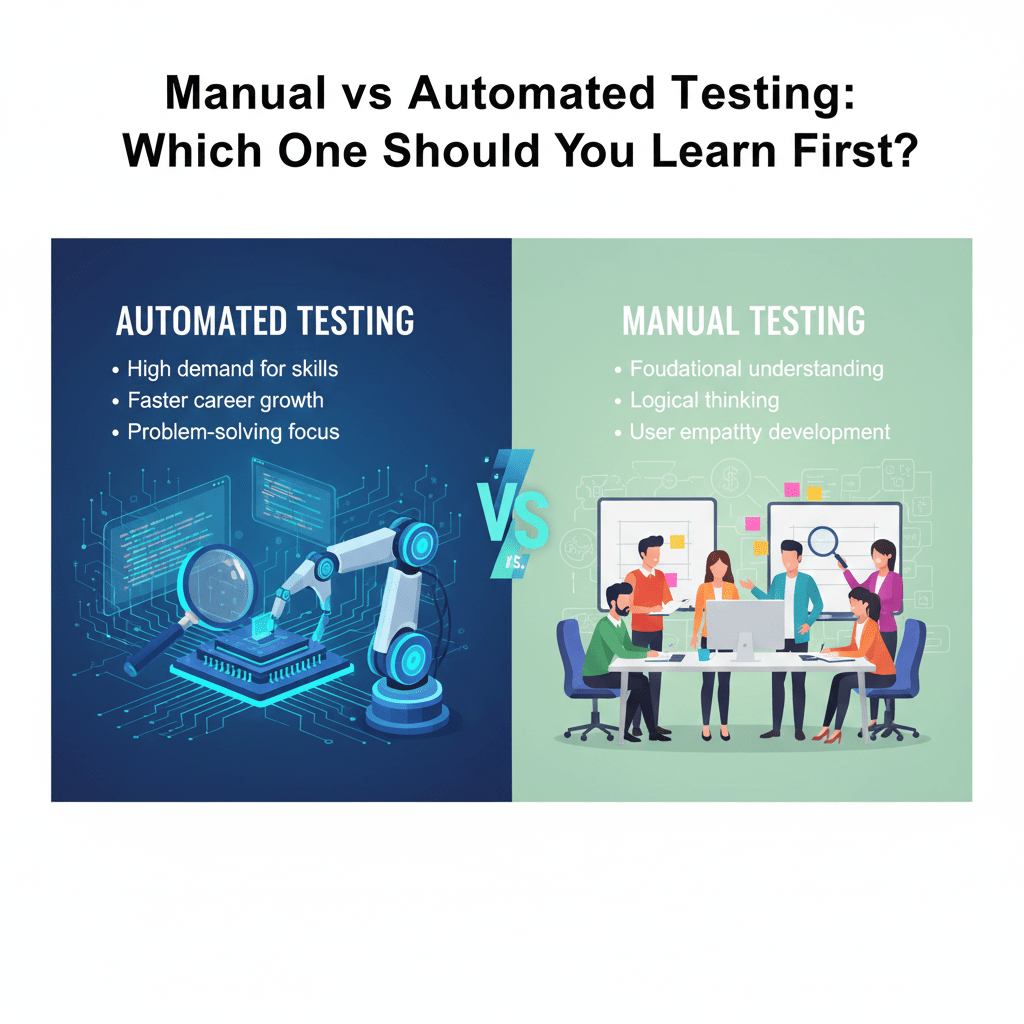
The software testing profession offers a wide range of career opportunities, making it one of the most in-demand fields within the tech industry. However, beginners often face a major question: Should I learn manual testing first, or should I go straight into automated testing? Both paths offer strong career prospects, yet each comes with unique learning curves, skills, and practical applications.
This comprehensive guide explains the differences between the two, highlights their advantages, and helps you decide which one you should learn first based on your goals, background, and market demand.
Understanding Manual Testing
Manual testing is the process of executing test cases by hand—without using automation scripts or testing tools—to identify defects, assess user experience, and validate software behavior. Testers rely on intuition, analytical skills, and knowledge of user flows to verify whether the application meets requirements.
What Manual Testing Involves?
- Understanding requirements and user stories
- Writing and executing test cases
- Performing exploratory tests
- Reporting and documenting bugs
- Validating UI/UX behavior
- Collaborating with developers and product teams
Why Manual Testing Is Important?
Even though automation is growing rapidly, manual testing remains crucial because:
- Humans can understand usability, aesthetics, and logical flow better than machines.
- Early-stage features change often, making automation impractical.
- Exploratory and ad-hoc testing rely on creativity, not code.
Understanding Automated Testing
Automated testing uses tools, frameworks, and scripts to validate software functionality without manual intervention. It is typically used for repetitive tasks, regression cycles, performance testing, and large-scale applications.
What Automation Testing Involves
- Writing scripts using programming languages
- Running test suites through automation tools
- Building frameworks for test execution
- Integrating tests with CI/CD pipelines
- Debugging failures in automated scripts
- Maintaining automation code with evolving features
Popular Automation Tools
- Selenium
- Cypress
- Playwright
- Appium
- JUnit/TestNG
- Postman/Newman for API automation
- JMeter for performance testing
Key Differences Between Manual and Automated Testing
| Aspect | Manual Testing | Automated Testing |
| Execution Method | Performed by humans | Performed by scripts/tools |
| Speed | Slower | Very fast |
| Accuracy | Human error possible | Highly consistent |
| Skills Needed | Analytical, communication | Programming + testing logic |
| Best Use Cases | UX, exploratory, ad-hoc | Regression, performance, CI/CD |
| Learning Curve | Easier | Moderate to difficult |
| Cost | Low initial cost | High initial setup cost |
Should You Learn Manual Testing First?
For most beginners, yes—manual testing is the recommended starting point. Here’s why:
1. Builds Strong Testing Fundamentals
Testing concepts such as:
- test scenarios
- test cases
- bug reporting
- software development lifecycle (SDLC)
- software testing lifecycle (STLC)
are easier to grasp without the added complexity of tools and programming.
2. Helps You Develop Critical Thinking
Manual testing teaches you how to:
- think like an end user
- identify edge cases
- analyze unexpected behavior
- understand user experience impacts
These skills form the foundation of every great QA engineer.
3. Required Before Automation in Most Companies
Even automation testers need to understand:
- testing concepts
- coverage criteria
- workflows
- scenarios
Automation is simply a faster way to execute tests—but the logic still comes from manual understanding.
4. No Coding Skills Needed Initially
This makes manual testing highly accessible for:
- career changers
- recent graduates
- non-technical professionals
Once fundamentals are strong, transitioning into automation becomes far easier.
Why Some People Prefer Learning Automation First?
Although manual testing is typically recommended as the first step, some learners choose to focus on automation first—especially those with programming experience.
1. Faster Entry into Higher-Paying Roles
Automation testers generally earn more than manual testers. Those who already know programming can accelerate their learning curve.
2. Growing Industry Demand
Companies with CI/CD pipelines expect testers to write scripts that run automatically after every code change. Learning automation early positions you as a modern QA professional.
3. Ideal for Developers Pivoting to QA
If you’re already familiar with:
- JavaScript
- Java
- Python
- C#
You may find automation frameworks intuitive.
Real-Life Comparison: What You Learn First Matters
Scenario 1: Testing a New App Feature (Manual First Makes Sense)
A product team releases a new chat feature for a mobile app. The UI changes daily. Writing automation scripts now would require constant updates. Manual testers can quickly:
- explore different flows
- identify visual glitches
- test usability
- uncover logic gaps
Conclusion: Manual testing knowledge is more useful here.
Scenario 2: Running Regression Tests for a Banking System
A banking application has 1,000+ test cases that must be executed after every release. Doing this manually is slow and costly. Automated tests:
- run in minutes
- verify complex logic
- maintain consistency
- reduce human error
Conclusion: Automation concepts are essential.
Scenario 3: Performance Testing a Social Media App
When simulating:
- 20,000 concurrent users
- rapid message exchanges
- high-volume uploads
Manual testing is impossible. Automation tools like JMeter or Gatling are required.
Conclusion: Automation skills are indispensable in performance testing.
So… Which One Should You Learn First?
Here’s a simple decision guide:
Learn Manual Testing First If:
- You are new to tech
- You want to understand testing fundamentals
- You are switching careers
- You prefer non-coding roles initially
- You want to build a strong foundation before moving to automation
Learn Automation Testing First If:
- You already know programming
- You prefer technical roles
- You want to specialize in CI/CD and DevOps testing
- You aim for higher-paying roles quickly
- You enjoy scripting and debugging
The Best Path: Learn Manual Testing → Then Learn Automation
Most QA professionals agree that the strongest testers are those who master manual testing first, then automation. This path ensures you understand:
- testing logic
- user behavior
- coverage gaps
before jumping into writing scripts.
Automation without manual fundamentals often leads to:
- poor test design
- misinterpreted failures
- fragile scripts
- incomplete coverage
Manual knowledge ensures you create automation that is meaningful and effective.
Career Opportunities: Manual vs Automation Testing
Manual Testing Roles
- QA Analyst
- Manual Test Engineer
- UI/UX Tester
- Acceptance Tester
- Functional Tester
Automation Testing Roles
- Automation Test Engineer
- SDET (Software Development Engineer in Test)
- Performance Test Engineer
- DevOps Automation Specialist
- API Automation Engineer
Automation roles often come with:
- higher salaries
- greater technical responsibilities
- involvement in CI/CD processes
Conclusion
Both manual and automated testing are essential in the software development process. However, for most beginners, manual testing is the best starting point. It builds a strong understanding of testing principles, user behavior, and defect identification. Once these fundamentals are solid, transitioning into automation becomes easier, faster, and more meaningful.
Automation offers immense career growth, but its success is rooted in solid manual testing skills. Ultimately, the best approach is to learn both—starting with manual testing, then progressing to automation for a complete QA skill set.
Frequently Asked Questions
1. Do I need to know programming to start automation testing?
Yes. Basic programming knowledge is necessary for writing automation scripts. However, you can first learn manual testing while gradually building your coding skills.
2. How long does it take to learn manual testing?
Most beginners can understand manual testing fundamentals in 4–8 weeks, depending on the depth of study.
3. How long does it take to learn automation testing?
It typically takes 3–6 months to become comfortable with automation tools, scripting, and frameworks.
4. Can I learn automation testing without manual testing experience?
You can, but it is not recommended. Without manual fundamentals, automation scripts often lack proper coverage and structure.
5. Which testing role pays more?
Automation testers and SDETs generally earn higher salaries than manual testers due to the technical skills involved.
6. Is manual testing becoming obsolete?
No. Manual testing is still essential for exploratory, usability, and user interface testing—areas where human judgement is crucial.
7. Should beginners aim for SDET roles?
SDET roles require strong programming skills and automation expertise. Beginners can aim for these roles but should start with manual testing to build foundational knowledge.
8. What skills are needed to become an automation tester?
You’ll need:
- programming fundamentals
- understanding of test frameworks
- knowledge of CI/CD
- debugging skills
- strong manual testing basics