Quality Assurance (QA) remains a cornerstone of successful product development, ensuring that software and engineering systems meet performance, reliability, and user expectations. As organizations adopt rapid delivery pipelines, the debate between automated testing and manual testing has grown more relevant than ever. Both approaches have unique strengths, limitations, and ideal use cases. Determining which is “better” depends largely on the project goals, resources, and the stage of development.
This article explores the differences, advantages, disadvantages, and practical considerations for choosing between automated engineering testing and manual testing.
What Is Automated Engineering Testing?
Automated engineering testing involves using scripts, testing frameworks, and specialized tools to run predefined test cases without human intervention. These tests are designed to execute repetitive, high-volume, or complex scenarios faster and more consistently than manual methods.
Common Uses of Automated Testing
- Regression testing
- Performance and load testing
- Continuous Integration/Continuous Deployment (CI/CD) pipelines
- Repetitive functional tests
- Large-scale simulation or stress scenarios
- API and integration testing
Key Tools
Selenium, Cypress, JUnit, Robot Framework, Postman/Newman, Jenkins, JMeter, and specialized engineering simulation tools.
What Is Manual Testing?
Manual testing relies on human testers who execute test cases without automation tools. It emphasizes exploratory skills, intuition, and real-time feedback on usability, logic, and appearance.
Common Uses of Manual Testing
- Usability testing
- Exploratory testing
- Ad-hoc and real-user scenario testing
- Initial test case creation and validation
- System testing during early, unstable builds
Key Differences Between Automated and Manual Testing
| Factor | Automated Testing | Manual Testing |
| Speed | Very fast; can run 24/7 | Slower; limited by human pace |
| Accuracy | Highly consistent | Subject to human error |
| Cost Over Time | High initial cost, low long-term cost | Low initial cost, higher long-term cost |
| Exploratory Ability | Limited | Very strong |
| Scalability | Excellent | Limited |
| Maintenance | Requires regular script/tool updates | Requires human resource allocation |
Advantages of Automated Engineering Testing
1. High Speed and Efficiency
Automated tests run significantly faster than manual tests, often completing large regression suites in minutes. This accelerates development cycles and helps support agile and DevOps methodologies.
2. Greater Accuracy
Machines follow scripts exactly, which eliminates inconsistencies and errors that may arise from human fatigue or oversight.
3. Cost-Effective in the Long Run
While automation tools require upfront investment, they reduce repetitive work and save money over repeated runs—especially in large, continuously evolving environments.
4. Reusability and Scalability
Once built, automated test scripts can run across various devices, configurations, and build versions with minimal extra cost.
5. Ideal for CI/CD Pipelines
Automation integrates seamlessly with CI tools such as Jenkins, GitHub Actions, and Azure DevOps. This ensures that every code change is validated consistently and immediately.
6. Capable of Complex and High-Load Scenarios
Automation tools can simulate:
- thousands of concurrent users
- heavy data throughput
- stress or endurance conditions
These scenarios are impossible to replicate manually at scale.
Advantages of Manual Testing
1. Better for User Experience (UX) Evaluation
Humans can identify issues related to:
- visual alignment
- aesthetics
- intuitive flow
- emotional user response
Automation cannot judge “feel,” usability, or user satisfaction.
2. Effective for Exploratory Testing
Manual testers use intuition and experience to uncover unexpected bugs that automated scripts—designed only to follow predefined rules—might miss.
3. Low Upfront Investment
No automation frameworks or script development is necessary. This makes manual testing ideal for:
- early prototypes
- short-term projects
- small-scale applications
4. Flexible and Adaptable in Unstable Environments
When software is still evolving and user interfaces change frequently, manual testers can adapt quickly without requiring repeated script updates.
5. Strong at Identifying New Test Scenarios
Humans often create and refine initial test cases based on user stories, business logic, and edge-case discovery—steps that automation later executes.
Limitations of Automated Testing
1. High Initial Investment
Automation tools, training, and scripting require time and financial resources. Small teams may struggle to justify the costs.
2. Maintenance Overhead
Flaky tests, UI updates, and changing requirements mean that scripts must be continuously updated.
3. Limited Exploratory Capabilities
Automation cannot adapt to unexpected scenarios—it only follows scripted instructions.
4. Not Suitable for All Test Types
Automated testing struggles with:
- usability testing
- visual consistency checks
- emotional or intuitive evaluations
Limitations of Manual Testing
1. Time-Consuming
Running repetitive regression or performance tests manually is slow and inefficient.
2. Human Error Risk
Manual testers may overlook details or make mistakes, especially when tired.
3. Scalability Challenges
Manual work does not scale efficiently as the product grows; more testers must be hired to handle increased workload.
4. High Long-Term Cost
Repetitive tasks require ongoing human effort, making long-term execution expensive.
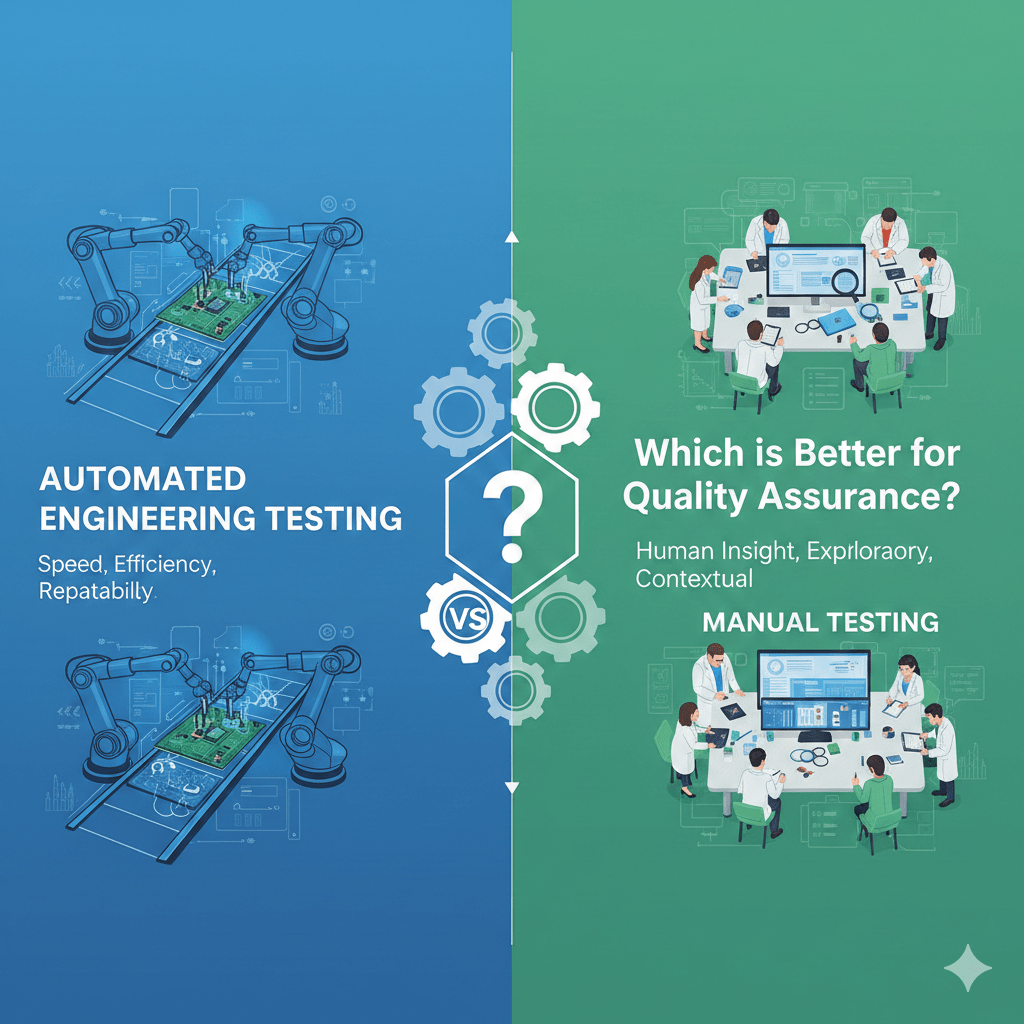
Which Is Better for Quality Assurance?
The real answer: neither method is universally better—each is essential in a comprehensive QA strategy.
Automated Testing Is Better When:
- the product requires frequent regression tests
- you have fast development cycles
- performance/load testing is needed
- you want continuous integration and deployment
- the goal is to reduce long-term testing cost
Manual Testing Is Better When:
- testing for usability, design, or user flow
- exploring new features or early-stage products
- dealing with dynamic, rapidly changing interfaces
- validating scenarios that require human judgment
The Ideal Approach: A Hybrid Strategy
Modern QA teams use a blend of both methods:
- Automation for speed, reliability, and scalability
- Manual testing for intuition, discovery, and user-focused insights
This combined approach strengthens product quality, shortens release cycles, and reduces risk.
Conclusion
Choosing between automated engineering testing and manual testing isn’t a matter of “which is better” overall—it’s about choosing the right method for the right situation. Automation delivers speed, repeatability, and long-term cost efficiency. Manual testing brings human insight, adaptability, and exploratory power.
A balanced, hybrid strategy ensures comprehensive coverage, optimized workflows, and high-quality outcomes—exactly what modern QA demands.
Frequently Asked Questions
1. Is automated testing always faster than manual testing?
Yes. Automated tests run significantly faster, especially for repetitive or large regression suites. However, the initial creation of automated tests may take longer than running them manually once.
2. Can automated testing completely replace manual testing?
No. Automated testing can’t evaluate usability, human experience, emotional response, or unexpected behavior. Manual testing remains essential for exploratory and UX-focused activities.
3. When should I prioritize manual testing?
Use manual testing during early development stages, for exploratory tests, or when validating new and changing features where automation would require constant script updates.
4. What types of tests should always be automated?
Regression, performance, load, stress, API, and integration tests are strong candidates for automation because they benefit from repeatability and speed.
5. Is automated testing expensive?
The initial costs—tools, training, and script development—can be high. But over time, automation becomes cost-efficient by reducing labor for repetitive test cycles.
6. How do I choose between manual and automated testing?
Consider factors like project duration, stability of the application, budget, testing frequency, and the need for user feedback. Often, a hybrid strategy is best.
7. Does automation reduce the need for QA testers?
Automation changes the role rather than eliminating it. Testers shift toward planning, designing tests, analyzing results, and managing automation frameworks.