In the world of networking, understanding how many devices communicate is essential. Two models often discussed in this context are the OSI (Open Systems Interconnection) model and the TCP/IP (Transmission Control Protocol/ Internet Protocol) model. While they serve similar purposes – helping us understand how data travels across networks – they differ in structure, design, and practical use.
One article of devopstraininginstitute.com says in 2025 DevOps engineers should master both OSI and TCP/IP models to optimize network performance and troubleshooting.
This article provides a comprehensive comparison between OSI and TCP/IP models, covering their layers, functions, protocols, and key differences to give you a clear understanding of how each model operates.
What is OSI Model?
The OSI model is a conceptual framework created by the International Organization for Standardization (ISO) to standardize networking functions into seven distinct layers. It is mostly used for learning and conceptual understanding rather than practical implementation.
The 7 Layers of OSI and Their Functions
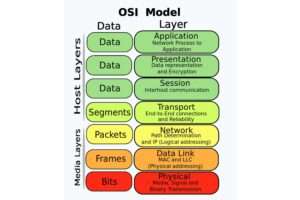
#1. Physical Layer
- Transmits raw binary data over a physical medium (cables, radio signals).
- Example: Ethernet cables, fiber optics.
#2. Data Link Layer
- Provides error detection and frames data for transmission.
- Example: Ethernet, PPP, MAC addresses.
#3. Network Layer
- Handles routing and logical addressing to deliver data across networks.
- Example: IP (Internet Protocol), ICMP.
#4. Transport Layer
- Ensures reliable or unreliable delivery of data between devices.
- Example: TCP (reliable), UDP (unreliable).
#5. Session Layer
- Manages sessions and connections between applications.
- Example: Establishing and terminating sessions in remote login applications.
#6. Presentation Layer
- Translates data formats, handles encryption/decryption and compression.
- Example: SSL, TLS, JPEG, ASCII.
#7. Application Layer
- Provides network services directly to user applications.
- Example: HTTP, FTP, SMTP, DNS.
The OSI model separates each networking function clearly, making it easier to troubleshoot and understand networking processes.
What is the TCP/IP Model?
The TCP/IP model is a practical and widely used framework that guides how the internet works. It is simpler than OSI, with four layers that combine certain OSI layers. TCP/IP is protocol-specific, meaning it defines the actual rules used in real-world networks.
The 4 Layers of TCP/IP and Their Functions
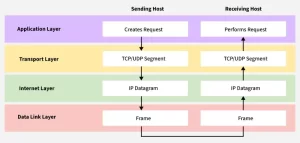
#1. Network Interface (Link) Layer
- Combines OSI’s Physical and Data Link layers.
- Handles the transmission of data over the physical network.
- Example: Ethernet, Wi-Fi, ARP.
#2. Internet Layer
- Equivalent to OSI’s Network layer.
- Handles logical addressing and routing.
- Example: IP, ICMP.
#3. Transport Layer
- Similar to OSI’s Transport layer.
- Ensures data is delivered reliably or unreliably.
- Example: TCP, UDP.
#4. Application Layer
- Combines OSI’s Application, Presentation, and Session layers.
- Provides network services to end-user applications.
- Example: HTTP, FTP, SMTP, DNS.
The TCP/IP model is more streamlined and used in real-world networking, particularly in the internet.
Layer By Layer Comparison of OSI and TCP/IP Models
| OSI Layer | Function | TCP/IP Layer | Equivalent Protocols |
| Physical | Transmits Raw Bits | Network Interface | Ethernet, Wi-fi |
| Data Link | Error Detection & Framing | Network Interface | ARP, PPP |
| Network | Routing & Addressing | Internet | IP, ICMP |
| Transport | Reliable/Unreliable Delivery | Transport | TCP, UDP |
| Session | Manages Session | Application | NA |
| Presentation | Data translation, encryption | Application | SSL, TLS |
| Application | Provides Services to Applications | Application | HTTP, FTP, SMTP, DNS |
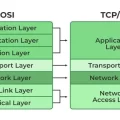
TCP/IP merges some layers of OSI for simplicity and practical implementation.
Why Understanding Both Models Matters?
- Networking Certifications: Knowledge of both models is essential for exams like CCNA, CompTIA Network+, and CISCO certifications.
- Troubleshooting: Helps identify where issues occur in the network.
- Protocol Knowledge: Knowing which protocols work at each layer improves network design and security understanding.
- Conceptual Clarity: Understanding OSI provides a strong foundation, while TCP/IP shows real-world application.
Conclusion
Understanding the OSI and TCP/IP models is crucial for anyone studying or working in networking. While OSI offers conceptual clarity, TCP/IP provides practical guidelines for real-world communication.
By mastering both, you can:
- Troubleshoot networks more effectively
- Prepare for certifications
- Understand protocol functions and relationships
- Map theoretical concepts to practical applications
Keep the comparison table and key differences in mind as a quick reference—it’s an excellent tool for exams, labs, and professional networking tasks.
Frequently Asked Questions
Q1: Are OSI and TCP/IP interchangeable?
A: No. OSI is a conceptual model for learning, while TCP/IP is a practical model for real networks. Understanding both gives you a complete perspective.
Q2: Which model is more widely used?
A: TCP/IP is the backbone of the internet and is widely used in real networks, whereas OSI is mainly educational.
Q3: Can OSI layers be mapped to TCP/IP layers?
A: Yes. OSI’s Physical + Data Link = Network Interface, Network = Internet, Transport = Transport, Session/Presentation/Application = Application.
Q4: Why does OSI have 7 layers but TCP/IP only 4?
A: OSI separates functions for conceptual clarity; TCP/IP merges layers for practicality.
Q5: Which protocols belong to the transport layer in both models?
A: TCP and UDP are the primary transport protocols in both OSI (Transport layer) and TCP/IP (Transport layer).