Have you ever wondered how information travels across the extensive amount of the Internet? The secret is in the structured, regular patterns according to which all digital communication is managed. The two most prevalent models in computer networking include the OSI Model (Open Systems Interconnection) and the TCP/IP Model (i.e., Transmission Control Protocol/Internet Protocol). Although both layers are used to describe the process, their structure highlight their key comparison.
OSI Model and its 7 Layers
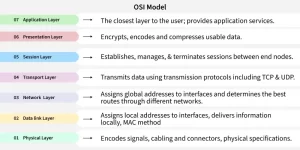
The OSI model is a conceptual protocol-independent scheme of reference, developed by the International Organization of Standardization (ISO). It is the best way to understand the concept of networking in detail with seven distinct layers.
The OSI is the reason to understand how networking works, while TCP/IP is about what and where of the current factual implementation of a network. It is imperative for aspiring IT professionals.
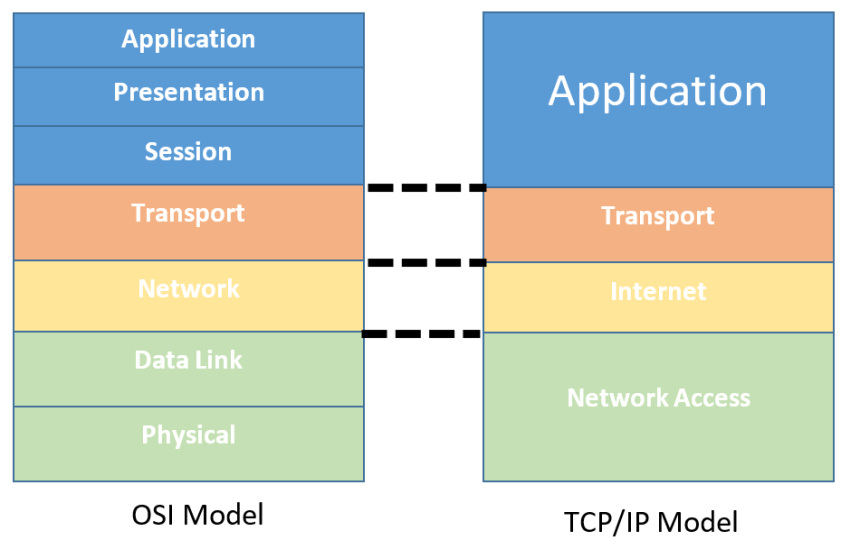
The OSI model has 7 layers as mentioned below:
- Physical Layer
- Data Link Layer
- Network Layer
- Transport Layer
- Session Layer
- Presentation Layer
- Application Layer
TCP/IP Model and its 4 Layers
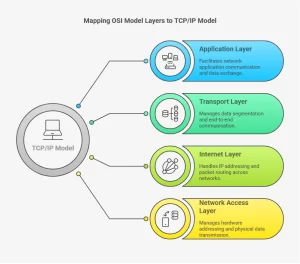
The TCP/IP model comprises four layers that outline how information is structured and sent over the Internet. Furthermore, it specifies a set of rules that deal with packetizing, addressing, routing, and reassembling data in order to establish a solid communication environment, one that is end-to-end. The TCP/IP model is a practical model and represents the framework for the Internet while also providing standard forms of network communication.
The TCP/IP Model has 4 layers as mentioned below:
- Application Layer
- Transport Layer
- Internet Layer
- Network Access Layer
OSI Model v/s TCP/IP Model
The OSI (Open Systems Interconnection) Model and the TCP (Transmission Control Protocol)/IP (Internet Protocol) Model are two models used to facilitate understanding of data being received and transported through various types of networks. Both models ingrain concepts of layered network communications; however, both models have different structures and purposes. To understand the differences is imperative for students and professionals involved with computer networks.
Viewsoft Academy: Unlock a New Skill with Industry-recognized Certifications

Do you have what it takes to go beyond the theory and learn the hands-on techniques required to design, administer, and troubleshoot networks? Viewsoft Academy is a provider of online certification programs with industry-standard online certifications like IT Networking and Fundamentals.
Our site is created based on a captivating user perception, as there are virtual labs where you can practice what you learn, and bring your theoretical knowledge with practical implementation based on the fundamental principles of the OSI and TCP/IP frameworks. Courses are designed by a top industry expert instructor who has years of experience in the industry, enabling the easier topics that are relatively hard to comprehend, such as network protocols, computer IP, data encapsulation, among others.
Viewsoft Academy offers you, through its capability to study according to your schedule, along with career-building opportunities that help you acquire the necessary hands-on skills, as well as the globally recognized certifications that you must have to become a competent participant in the competitive IT industry.
Frequently Asked Questions on the Comparison of the OSI Model and the TCP/IP Model
Question 1. Why are there 7 layers in the OSI model, but only 4 layers in the TCP/IP model?
Answer: The OSI model breaks down the entire networking into 7 layers to understand how things work and how to design them. While the TCP/IP layers are about the implementation of those concepts for real-world use. Having a better understanding of their difference helps you to know more about networking and its internals more simply.
Question 2: What are the key similarities between the OSI and TCP/IP models?
Answer: The architecture behind the two models applies layers to a logical definition of a communication process. They can organize structures used by developers to construct protocols and hardware to perform a particular set of functions to ensure interoperability, and enhance both the notions of data encapsulation as information passes down the stack before data transmission on the network.
Question 3. Is it good to learn TCP/IP directly without studying the OSI model?
Answer:Yes, you can, but you might face some challenges as they are interlinked; the concepts that you learn in OSI will help you to understand TCP/IP. OSI is like a blueprint for TCP/IP, where you learn how to implement those concepts practically. Once you know OSI, then it will become much easier for you to understand TCP/IP.
Question 4: What is the best way Viewsoft Academy promotes applied skills networking courses?
Answer: Viewsoft Academy focuses on highly practical training based on strong and interactive virtual laboratories and practical projects. With hands-on experience, learners configure network devices, troubleshoot more complex situations, and apply network protocols such as TCP and IP in an abstracted setting. Also, they can directly apply their theoretical learning on the OSI and TCP/IP models into practical use and job-ready skills for the IT industry.
Question 5: Are the networking courses offered by the Viewsoft Academy beneficial for beginners?
Answer: Yes, the courses offered by Viewsoft Academy are designed keeping in mind that everyone can learn and understand every concept easily. The course is prepared by top industry experts who have years of expertise in the IT field. The course has no prerequisites, which means you can learn at any stage, even if you have no prior knowledge or if you don’t have a technical background. The course flow will help you to understand every bit of it.
Question 6: What is the key difference between TCP and IP?
Answer: TCP (Transmission Control Protocol) is the Transport Layer, which provides reliable sending and receiving, ordered information, and checks that ensure that information is delivered between applications. IP (Internet Protocol) is an Internet/Network Layer protocol software that manages the logical addressing (IP addressing) and routing of data packets between source and destination across a variety of networks and is core to the entire Internet protocol suite.
Question 7: How will the Viewsoft Academy certification help me in relation to my career?
Answer:Viewsoft Academy certifications are recognized at the industry level, which helps to validate your skills. It will help you to land your dream company, or if you are looking to excel in your career, then this course certification will help you, too.