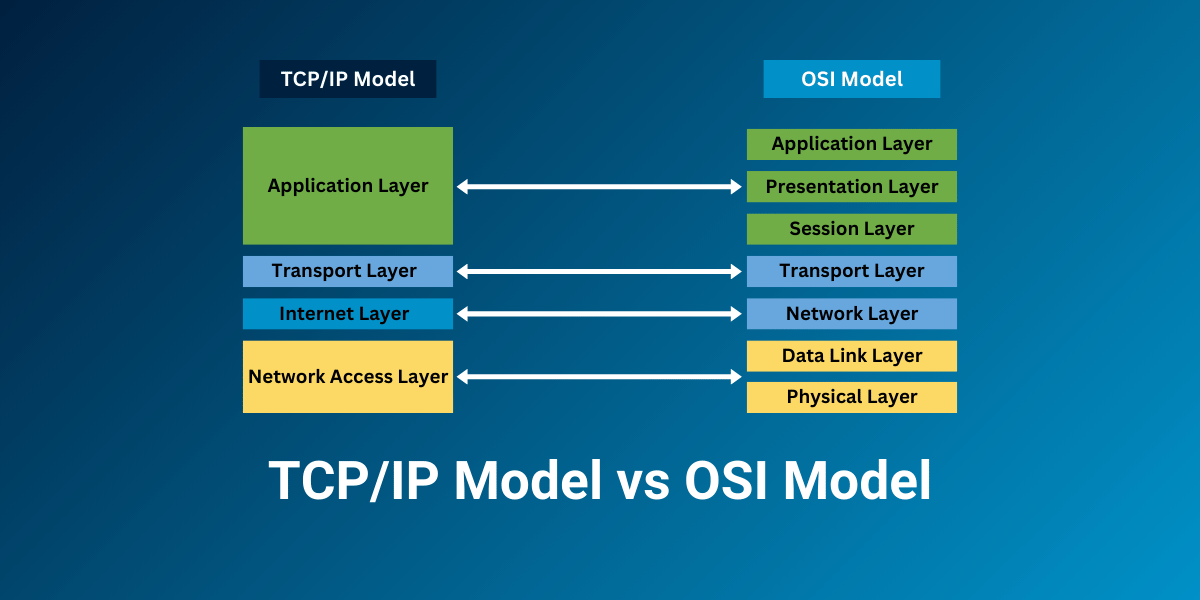
Computer network models facilitate establishing a connection between the sender and the receiver and smoothly transmitting the data. There are two most popular computer networks: OSI model and TCP/IP model. While OSI is a reference model that describes the functions of a networking system, TCP/IP is the communication protocol suite to connect network devices to the internet.
While both models provide framework for understanding how data is transmitted and received across networks, they differ in their approach and organization. In this article, we will understand the key difference between OSI and TCP/IP model along with their respective layers.
What is OSI Model?
OSI stands for Open System Interconnection. The OSI model was developed by ISO to help standardize communication between computers. The original objective behind the OSI model of computer networking was to make communication possible between two vendors. Because when the internet was growing at the beginning of the time, different vendors could not communicate with each other and, OSI model came as the standard model for discussing, teaching, and learning the networking procedures in the field of information technology.
So, the OSI model was developed, but it was never implemented and remained as just a reference model for study purposes only.
OSI Model Layers
There are 7 layers of OSI model.
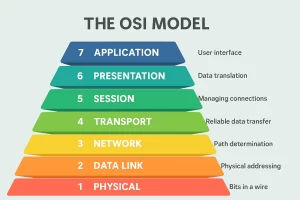
Layer 1 – Physical Layer: This layer handles data transmission through cables, radio waves, etc.
Layer 2 – Data Link Layer: This layer makes sure the data transfer between adjacent nodes is error free.
Layer 3 – Network Layer: This layer is responsible for routing data packets between different networks.
Layer 4 – Transport Layer: It makes sure the data is transferred with protocols like TCP and UDP.
Layer 5 – Session Layer: It manages session and connections between network devices.
Layer 6 – Presentation Layer: This layer handles data formatting, encryption, and connection.
Layer 7 – Application Layer: This layer supports application services like email and browsing.
To know more, read our blog on Layers of OSI and TCP/IP models.
What is TCP/IP Model?
The TCP/IP model in computer networks was designed by the Department of Defense, and it is based on standard protocols. This model is also known as IP Stack, and this model is practically being implemented. This model is a widely adopted model due to its simplicity, and it is also known as the concise version of OSI model.
TCP Layers
As compared to OSI Model, there are 4 TCP layers which are:
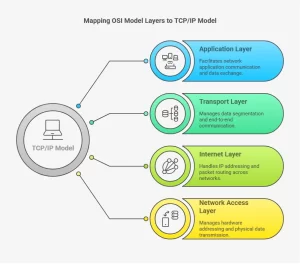
Layer 1: Network Interface: This layer combines the physical and Data Link layers of the OSI model for hardware communication.
Layer 2: Internet Layer: It focuses on addressing and routing via IP.
Layer 3: Transport Layer: This layer is responsible for reliable data delivery, and it does that with the help of protocols like TCP.
Layer 4: Application Layer: This layer is the combination of the top three layers of OSI model and handles user interaction.
Key Differences Between OSI and TCP/ IP Model
Here are the key differences between TCP/IP and OSI Models in a tabular form –
| Parameters | OSI Model | TCP/IP Model |
| Full Form | Open Systems Interconnection | Transmission Control Protocol/Internet Protocol |
| Layers | OSI Model has 7 Layers | TCP/IP Model has only 4 Layers |
| Development | It was developed by ISO | It was developed by DOD |
| Usage | Its the reference model used for study purposes, never implemented | This is the concise version of OSI, and it is logical model which is being implemented |
| Approach | It follows a vertical approach | It follows a horizontal approach |
| Service | Provides quality services | Doesn’t provide quality services |
| Dependency | It is a protocol-independent standard, and it acts as a communication gateway between network and end-user. | It is based on standard protocols. This is a protocol for communication that allows hosts to connect to networks. |
| Delivery | It guarantees the delivery of package | It doesn’t guarantee package delivery |
| Reliability | Less Reliable | Very Reliable |
| Ease of Change | Changes can be done easily in this model | It is not easy to make changes in TCP/IP Model. |
You can also go through our blog on Comparison of OSI model and TCP/IP model.
Conclusion
Technologies such as cloud computing, IoT, and 5G are transforming the world of networking, yet the functional models OSI and TCP/IP remain relevant. In this blog, we have covered the difference between OSI Model and TCP/IP model. OSI is a generic model and is based on the functions of each layer. On the other hand, TCP/IP is a protocol-oriented model.
This knowledge is valuable in the long term, whether for troubleshooting, system architecture, or preparing for certifications. Whether it is OSI or the TCP/ IP model, both hold a permanent place in the modern network technology, being essential for professionals who aim to master both theoretical concepts and practical solutions.
Frequently Asked Questions
Why do we use TCP/IP model over the OSI model?
OSI is a theoretical model. This model does not take into consideration the availability of appropriate technology. It lays out the guidelines on how communication needs to be done and lacks practical implementation. On the other hand, TCP/IP provides standards on which the Internet was developed. It is a more practical model.
What is the key difference between TCP/IP and the OSI Model?
The key difference between the OSI and TCP/IP models is that the OSI is a conceptual framework, while TCP/IP is a communication protocol suite. The OSI model offers seven layers with different functions that the TCP/IP model groups into four layers.
Is TCP/IP still used today?
It is one of the most commonly used protocols within digital network communications and ensures end-to-end data delivery.
What are the similarities between TCP and OSI models?
Both the TCP/IP model and the OSI model have a layered structure, describe the flow of communication, and support protocol independence. They both use data encapsulation and handle segmentation and reassembly. However, the TCP/IP model is more widely used, particularly in relation to the Internet.