Release Train Engineer vs. Project Manager: The Difference?: The Release Train engineer and the Project Manager happen to be the two very crucial functions that come to be in effect in case of running large-scale projects in the agile software development world. The Release Train Engineer and the Project Manager are both significant towards ensuring that the projects are functioning correctly, on time, and producing high-quality products. Their projects, project management framework, and how they manage are not the same. When it’s clear among organizations when these two roles come in, it does not take much effort to make decisions in an enhanced manner when delegating duties to teams.
What is the Release Train Engineer (RTE)?
A Release Train Engineer is a position that occurs in the Scaled Agile Framework (SAFe), an agile framework which used to grow agile techniques at large corporations. A servant-leader for an Agile Release Train (ART), which is a team of more than one agile-based team collaborating concurrently and on a shared set of objectives, is the RTE. The ART conforms with the objectives of the release of programs or products, and RTE makes sure that all groups coordinate to achieve the set goals.
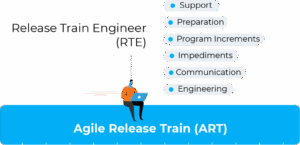
The major duties of the RTE consist of:
- Facilitation of ART ceremonies: They involve Program Increment (PI) Planning, ART Sync, Inspect and Adapt Sessions.
- Dependency Management: The RTE guarantees the identification and management of dependencies between teams.
- Enhancing alignment: RTEs collaborate with stakeholders in order to make sure the work of the ART meets the corporate goals.
- Continuous improvement: The RTE helps the teams to review their programs and make program-level improvements.
The task undertaken by the RTE is quite specific, and it deals with the functions of fulfilling the value in an operation process in terms of construction by persistent delivery pipes, cross-functional teamwork, and overall arrangement of agile teams. Although they neither influence the scope nor product vision decision-making specifically, their emphasis on the continuous organization of work across the various teams and their approach to handling program-wide risks are important to the successful large-scale agile implementations.
What is a Project Manager (PM)?
The Project Manager, in its turn, is a slightly more frequent job description of a Project Manager, which appears in both standard project management approaches like Waterfall, and in ad-hoc and hybrid ones. A PM has the responsibility of ensuring a project is completed successfully towards completion, which involves taking control over the timelines, budgets, scope, resources, and risks, among other things. Although a PM may not directly to be directly involved in the day-to-day activities of the team, he or she is responsible for making sure that the project is completed to its objectives on time and on budget.
The major responsibilities of a Project Manager are:
- Project planning: This includes project scope definition, scheduling, and making sure that resources are at hand.
- Risk management: The PM detects and eliminates risks that can cause a change in the project deadline or deliverables.
- Communication: PMs will ensure that communication among involved parties is maintained, there is an update of the progress achieved, and address issues that will emerge.
- Scope control: This is making sure that the project remains under control according to its scope and adjustments where appropriate.
- Team coordination: Making sure the team functions well, eliminating roadblocks, and ensuring the availability of resources.
In most instances, the Project Manager will be more oriented on the completion of a particular project (or initiative) over merging multiple teams, as the RTE would. The centralised task-oriented character of PMs is more preoccupied and agitated with project milestones and keeping the project within the time, cost, and scope triple basis.

Key differences between Release Train Engineer and Project Manager
Scope and Scale of Work:
- RTE: Focuses on higher-level coordination of programs and is principally concerned with the work of several teams in an ART.
- PM: Typically closer to a given project, and it would deal with a certain team (or a couple of teams) to produce the stipulated deliverables.
Methodology:
- RTE: These will be used under the Scaled Agile Framework (SAFe), another agile framework to be applied to larger organizations. The RTE concentrates on providing value in a step-by-step manner through the effort of a number of agile teams.
- PM: Is capable of working with any methodology, such as Waterfall, Agile, or Hybrid, and might not be so concerned with the agile tenet of iterative work and customer responses.
Responsibilities:
- RTE: Supports agile ceremonies, composites dependencies between teams, coordinates teams to project-level objectives, and promotes unrelenting progress in a partnered milieu.
- PM: The key role has to do with the area of managing the entire lifecycle of a project; that is, the start, through to completion, which encompasses scope, schedule, and resources, as well as communication.
Focus on Delivery:
- RTE: invests in team convergence, closes flow, and fetches consistent delivery of incremental value, frequently within a cadence of Program Increments (PIs).
- PM: Emphasizes completion of the project in time and under budget, in addition to meeting the scope and objectives of the project.
Team vs. Program Focus:
- RTE: Concentrates on how teams (typically 5-12 teams are coordinated in an ART ) and deliverables on a program level.
- PM: It involves smaller teams that PM often oversees and handles in the process of accomplishing certain project objectives and deliverables.
When to Use Each Role
RTE is a role of high importance in large-scale agile implementations. You will require an RTE to integrate among groups, eliminate bottlenecks, and make sure that the greater program objectives are satisfied whenever your organization is enrolling in SAFe or any other large-scale agile model. The RTE can be ideal in managing complex cross-functional programs where agile teams have to work together with one another.
Conversely, the Project Manager fits better the traditional project set-ups or projects that are of minor scale, as well as those where the scope is properly defined, and finally projects that have one specific product or goal. The PMs also perform well in situations in which the project has to be delivered hard and limited in terms of deadlines and budgets, and may not depend on cross-team coordination that an RTE offers as much as needed.
Conclusion
Despite similarities in the functionalities of the Release Train Engineer and Project Manager positions in terms of contributing to the success of services and products delivery, it is imperative to learn the magnitude of their role and how they address their work. The RTE is concerned about greater scale, bottleneck resolution, and permanent communication among teams in an agile program. A bigger interest of the PM is involved in the project lifecycle management and being within its scope, time, and budget constraints. The knowledge of the differences will enable the organizations to make a more objective choice regarding which role to utilize in particular cases. Finally, the decision between RTE and PM is focused on the size of the work and the methodology, and the intricacy of the project.
Frequently Asked Questions
Question 1. What is the primary role of a Release Train Engineer (RTE)?
Answer. The RTE organizes agile teams in a program, administers dependencies, supports agile ceremonies, maintains alignment of teams with the larger program objectives, and their cooperation. The Scaled Agile Framework (SAFe) employs RTEs to get more program-level delivery.
Question 2. What makes a Project Manager different from an RTE?
Answer. A Project Manager oversees the scope of a project, the budget, and resources throughout the entire lifecycle and with the help of relatively conventional project management tools. An RTE, however, does this and offers coordination across more than one team on the program level, often with a massively scaled agile framework (such as SAFe).
Question 3. Is an RTE also a Project Manager?
Answer. Despite this, though, there are certain similarities between the Project Manager and the RTE position; they differ greatly even in essence. The primary concern of a Project Manager is the provision of project-specific outcomes, whereas the main concern of the RTE is facilitating cross-team collaboration as a facilitator for Agile Release Trains (ARTs) within the larger agile system. At a smaller organization, the Project Manager might take up part of the same roles as the RTE.
Question 4. Does SAFe make an RTE a requirement?
Answer. The Release Train Engineer (RTE) is actually mentioned in the scaled agile framework (SAFe) role in the delivery of ARTs, where the release train speaker mediates among the agile teams. The RTE responsibilities are also a reasonable correspondence to the SAFe Principles, so this is a reasonable match.
Question 5. Which role can better fit a bigger-scale agile transformation?
Answer. On a bigger scale of agile transformation, the Release Train Engineer (RTE) is more suited. RTE is specially trained to deal with cross-team dependencies through coordination management, which plays a significant role in bigger agile transformations in the SAFe.