Anyone preparing for networking exams—such as CompTIA Network+, CCNA, or other IT certifications—will inevitably encounter questions about the TCP/IP model and the OSI model. These two conceptual frameworks are fundamental to understanding how networks operate, communicate, and troubleshoot issues. But exam questions often ask:
“Which statement is true about the TCP/IP and OSI models?”
While multiple-choice exams vary, there are several universally true statements that help clarify the relationship between the two models. This guide breaks them down in simple, exam-ready language. It also explains differences, similarities, layer functions, and test-style examples—so you’re confident on exam day.
True Statements About the TCP/IP and OSI Models
Here are the most accurate statements that align with standardized exam materials:
✔ 1. The TCP/IP model is a practical, implementation-based model, while the OSI model is a theoretical reference model.
- TCP/IP came from real-world DARPA and DoD network implementations.
- OSI was developed as a teaching and design framework.
Why it matters for exams:
Questions often test whether you can distinguish conceptual (OSI) vs. practical (TCP/IP) models.
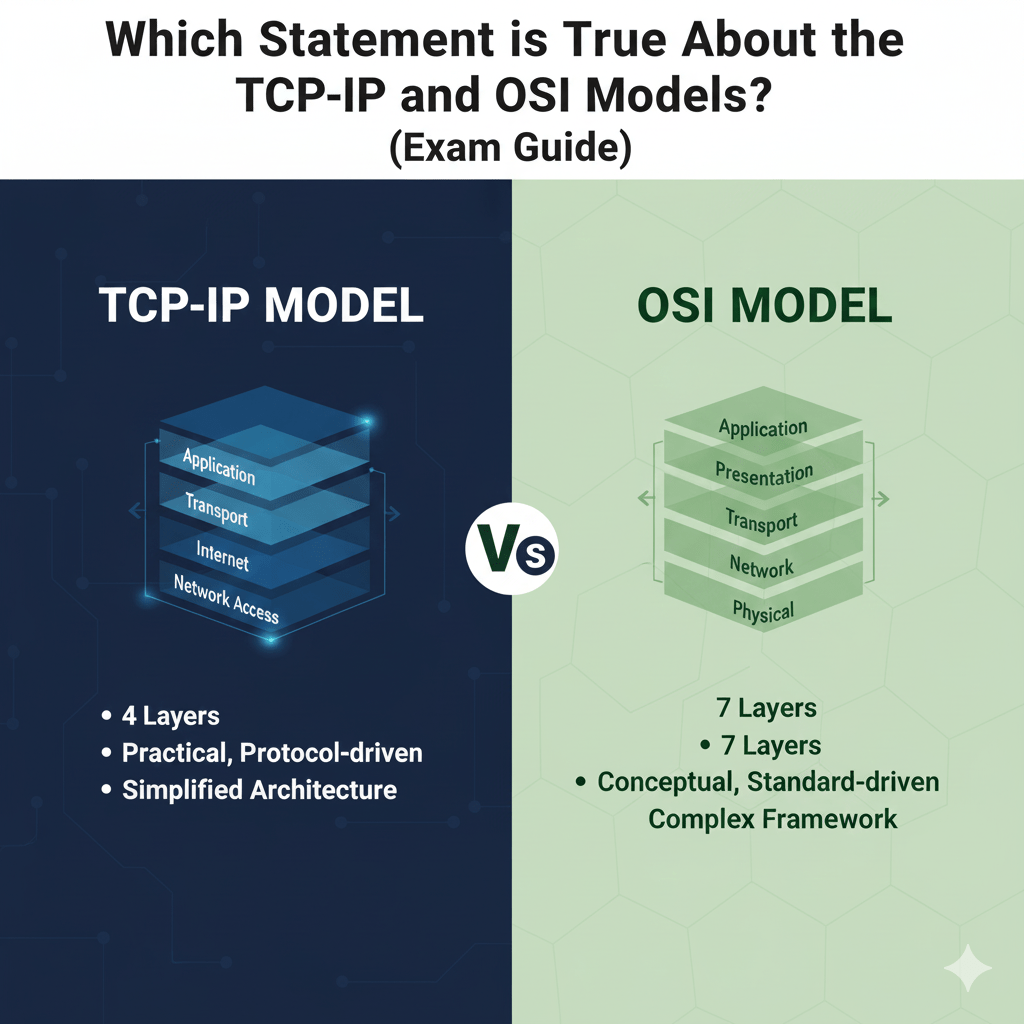
✔ 2. The OSI model has 7 layers, while the TCP/IP model has 4 layers (in most versions).
- OSI Layers: 7 total
- TCP/IP Layers: Typically shown as 4 (sometimes 5 depending on source)
This shows you understand structural differences.
✔ 3. The OSI model separates the Application, Presentation, and Session layers, while TCP/IP combines them into a single Application layer.
In other words, OSI divides responsibilities more granularly.
This is one of the most commonly tested facts.
✔ 4. TCP/IP is the model used for modern network communications, including the Internet.
The entire Internet is built on TCP/IP—not OSI.
Exam writers expect you to know which model is used in real-world technologies.
✔ 5. Both models describe network communication processes and help standardize protocols.
Although OSI isn’t used directly, it is still extremely valuable for understanding network functions.
✔ 6. The OSI model provides more detailed guidance for troubleshooting, especially in layers 5–7.
Because OSI has more layers, it helps categorize issues more precisely.
✔ 7. TCP/IP uses protocols within each layer, while OSI describes what layers should do but not how.
OSI = describes functions
TCP/IP = defines real protocols (TCP, UDP, IP, DNS, DHCP, etc.)
OSI Model: 7 Layers Explained for Exams
1. Physical
Cables, bits, NIC signals.
2. Data Link
MAC addresses, switches, frames.
3. Network
Routing, IP addressing, routers.
4. Transport
TCP, UDP, segmentation.
5. Session
Maintains sessions (NFS, SQL connections).
6. Presentation
Encryption, compression, formatting.
7. Application
User interfaces, protocols like HTTP, FTP, DNS.
TCP/IP Model: 4 Layers Explained
1. Network Interface (Link Layer)
Equivalent to OSI Layers 1–2.
2. Internet Layer
Equivalent to OSI Layer 3.
3. Transport Layer
Equivalent to OSI Layer 4.
4. Application Layer
Equivalent to OSI Layers 5–7 combined.
Mapping Between the Two Models (Important for Exams)
| OSI Layer | TCP/IP Equivalent Layer |
| Application (7) | Application |
| Presentation (6) | Application |
| Session (5) | Application |
| Transport (4) | Transport |
| Network (3) | Internet |
| Data Link (2) | Network Interface |
| Physical (1) | Network Interface |
This chart often appears in test questions asking you to match layers or identify where protocols belong.
Common Exam Questions & Answers
Below are examples of questions you may see in certification exams:
Question 1
Which statement is true about the TCP/IP and OSI models?
Correct Answer:
The TCP/IP model combines the OSI application, presentation, and session layers into a single Application layer.
Why:
This is one of the most widely recognized differences.
Question 2
Which model is used by the Internet today?
Correct Answer:
TCP/IP
Question 3
Which model is a conceptual teaching tool with 7 layers?
Correct Answer:
OSI
Question 4
Which layer of the TCP/IP model corresponds to the OSI Network layer?
Correct Answer:
The Internet Layer
Question 5
Which statement is true about protocol definitions in the OSI model?
Correct Answer:
The OSI model describes functions but does not specify actual protocols.
Why Two Models Exist
Understanding why both models exist helps answer conceptual questions on exams.
✔ OSI was created for standardization
It was designed to help vendors build compatible systems.
✔ TCP/IP came from real-world networking needs
The U.S. Department of Defense created it to support resilient, fault-tolerant communication systems.
✔ Today’s networks use TCP/IP
But network training uses the OSI model to simplify learning.
Key Differences (Exam-Crucial)
| TCP/IP Model | OSI Model |
| Real-world implementation | Theoretical reference |
| 4 layers | 7 layers |
| Uses real protocols like TCP, IP, HTTP | Describes functions, not exact protocols |
| Application layer = OSI 5–7 | Application, Presentation, Session separate |
| Standard for the Internet | Used mainly for teaching |
Similarities Between the Models
Exams sometimes ask this too.
✔ Both describe how network communication works
✔ Both break communication into layers
✔ Both support interoperability
✔ Both help troubleshoot network issues
✔ Both define responsibilities for each layer
Practical Example for Better Understanding
Imagine sending an email.
OSI Explanation
- Application: User composes email
- Presentation: Email formatted/encrypted
- Session: SMTP session established
- Transport: TCP ensures delivery
- Network: IP routes packet
- Data Link: Frame sent across network
- Physical: Bits on the wire
TCP/IP Explanation
- Application: SMTP handles content
- Transport: TCP manages segments
- Internet: IP determines route
- Network Interface: Frames and signals sent
The TCP/IP version is simpler—and that’s the key difference.
Which Model Should You Use for Troubleshooting?
✔ Use OSI for categorizing issues
- “Is it a physical cable problem?” → Layer 1
- “Is routing broken?” → Layer 3
- “Is the application slow?” → Layers 5–7
✔ Use TCP/IP for real-world diagnosis
- IP misconfiguration
- DNS failure
- TCP handshake issues
Both perspectives complement each other.
Conclusion
If you’re preparing for networking exams, remember the most important truths:
- TCP/IP is real-world; OSI is theoretical.
- OSI has 7 layers; TCP/IP has 4 (or 5).
- OSI splits Application functions into 3 layers; TCP/IP merges them.
- The Internet uses TCP/IP, not OSI.
- Both models help explain network communication and troubleshooting.
Memorizing these core statements will help you answer almost any exam question related to the two models confidently and accurately.
Frequently Asked Questions
1. Which model came first—TCP/IP or OSI?
TCP/IP came first (late 1970s). OSI was developed later in the 1980s as a standardized framework.
2. Why is OSI still taught if we use TCP/IP today?
Because OSI provides a more detailed, structured way to understand and troubleshoot networking concepts.
3. Is TCP/IP a strict replacement for OSI?
No. TCP/IP is the implementation model, while OSI remains a conceptual teaching model.
4. Which OSI layers are combined in the TCP/IP Application layer?
- Application
- Presentation
- Session
All three merge into a single TCP/IP Application layer.
5. Does TCP/IP have 4 or 5 layers?
Most modern textbooks and exams use the 4-layer version, but some sources describe a 5-layer version. For exams, stick to the version specified by your certification body.
6. Which layer handles encryption in the OSI model?
The Presentation Layer (Layer 6).
7. Are protocols like HTTP and DNS part of the OSI or TCP/IP model?
They are TCP/IP Application layer protocols, though in the OSI model they are conceptually placed in Layers 5–7.
8. Which layer of OSI corresponds to IP?
IP is part of the Network Layer (Layer 3).
9. Do routers operate at OSI Layer 3?
Yes, routers function primarily at the Network (Layer 3) level.
10. What layer does TCP belong to?
TCP belongs to the Transport Layer in both models.