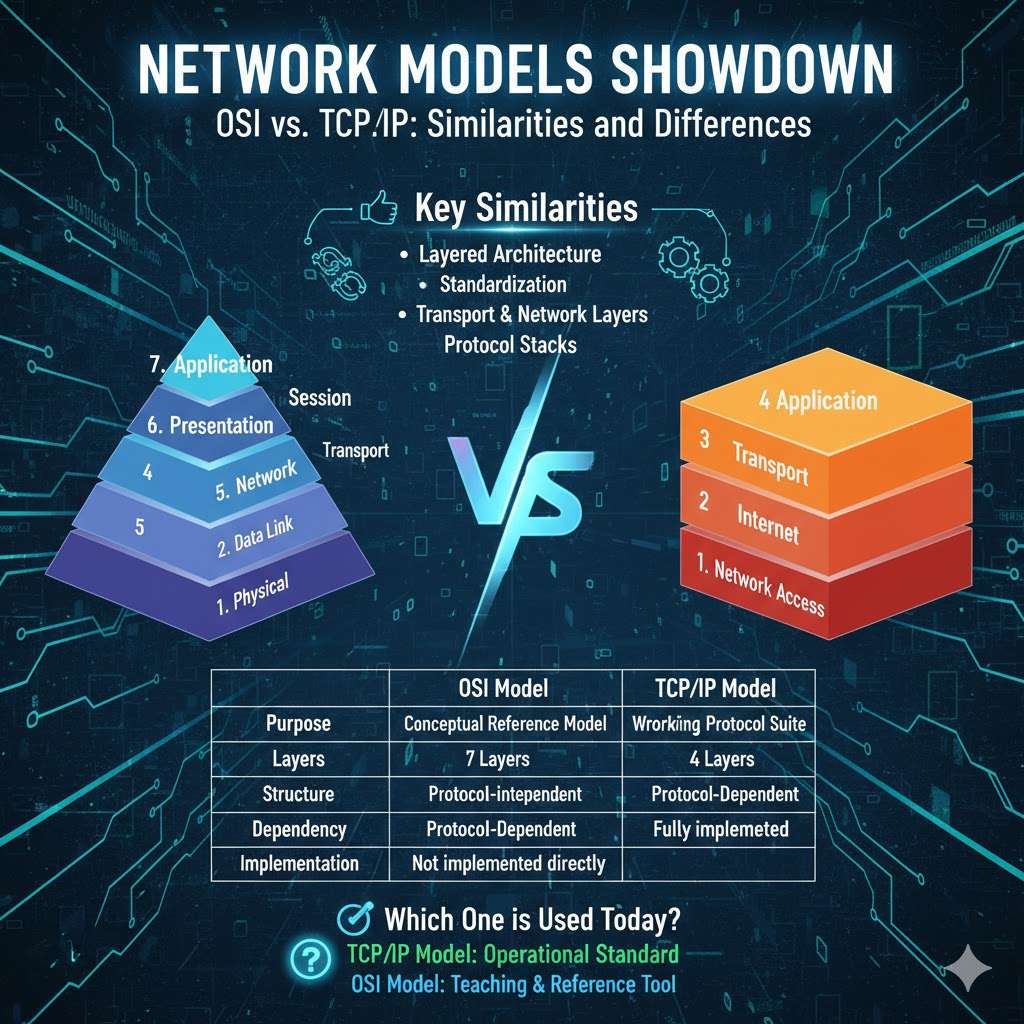
OSI model is an architecture of 7 layers in which each layer has its own function to perform. In contrast, TCP/IP is a concise version of the OSI model. The TCP/IP model consists of 4 layers rather than 7 layers of the OSI model. In this article, we will look into the similarities and differences between OSI and TCP/IP models of the networking.
Both OSI and TCP/IP models are layered frameworks for understanding network communication, and they share similarities like having layers with specific functions, a transport layer for end-to-end data delivery, and a physical layer for hardware interaction.
OSI Model – A Brief Explanation
Open System Interconnection consists of 7 layers and every layer has a certain function to it. Here are the layers from which the data is flowed before reaching its destination, starting from the bottom layer and ending at the top layer when the data is transferred from one location to another location in the globe with the help of networking.
Layers of OSI Model
- Physical layer
- Data Link Layer
- Network Layer
- Transport Layer
- Session Layer
- Presentation Layer
- Application Layer
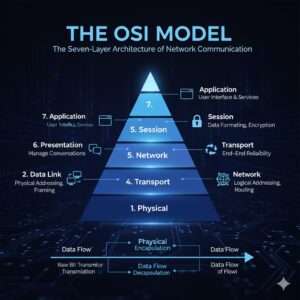
Characteristics of the OSI Model
- A layer must be created in which the particular stages of abstraction are needed in the OSI reference model.
- The characteristic of every layer must be decided on as a consistent with the world over OSI layers’ standardized protocols.
- The wide variety of OSI reference models in computer networks must be huge in order that separate capabilities must now no longer be positioned within side the identical layer. At the identical time, it must be small sufficient in order that the structure doesn’t emerge as very complicated.
- In the OSI model, every layer is based on the subsequent decreased layer to carry out primitive capabilities. Every stage must be capable of providing offerings to the subsequent layer.
- Changes made in a single layer now no longer want modifications in different layers.
TCP Model – A Brief Explanation
The transmission control protocol is shortly called TCP/IP model. This consists of 4 layers and every layer has a certain layer to it. Here are the layers from which the data is flowed before reaching its destination starting from the bottom layer and ending at the top layer when the data is transferred from one location to another location in the globe with the help of networking. These are the layers present in the TCP/IP model.
Layers of TCP/IP Model
- Application Layer
- Transport Layer
- Internet Layer
- Network Access Layer
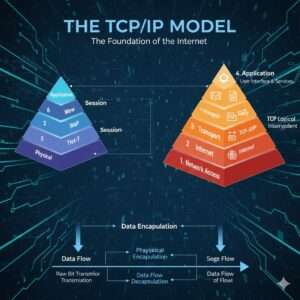
Characteristics of TCP/IP Model
- Stream Data Transfer: Applications running on the application layer transfer a contiguous movement of bytes to the lowest layers.
- Reliability: The maximum essential function of TCP is dependable records delivery in order to offer reliability.
- Flow control: Network devices function at special information charges due to different factors like CPU and to be had bandwidth. It can also additionally take place as a sending tool to send information at a miles quicker charge than the receiver can handle.
- Multiplexing: Multitasking is carried out through the use of port numbers.
- Connections: Before utility techniques can send information through the use of TCP, the devices have to set up a connection.
- Full duplex: TCP affords concurrent records streams in each direction.
- Adding greater structures to a network is easy.
- In TCP/IP, the community stays intact till the supply and destination machines had been functioning properly.
- The TCP layer is a connection-orientated protocol.
- TCP gives reliability and guarantees that statistics that arrive out of series have to be positioned back into order.
- TCP/IP layers permit you to put in force go with the drift control, so the sender is in no way a receiver with statistics.
Similarities Between OSI and TCP/IP Models
| Similarities | TCP/IP and OSI Model |
| Model | Both TCP/IP are logical models. |
| Structure | Both are arranged layered wise which is also called an architectural model. These models have a stack of protocols it means the protocol is arranged in every layer. Both models have some set of protocols. |
| Networking | Both TCP/IP defines standards for networking. |
| Framework | Both TCP/IPs provide a framework for creating and implementing networking standards and devices. |
| Communication process | Both TCP/IPs simplify and divide the network communication process into making their layers. |
| Similar components | In Both TCP/IP models manufacturer allows making sets of devices and network components that can co-exist and work with the devices and components that are made by the other manufacturers. |
| Functionality | In both TCP/IP models, a single layer defines a particular functionality and set standards for that functionality only. |
| Troubleshooting | Both the TCP/IP models simplify their troubleshooting process by dividing the layer’s complex functions into simpler components of the layer. |
| Ethernet standards | Instead of defining the already defined standards and protocols in both the TCP/IP models. For example, the Ethernet standards were already defined by IEEE before proceeding to create these models. So instead of defining them again in both the models of IEEE Ethernet standards. |
Difference Between OSI and TCP/IP Models
| OSI Model | TCP IP Model |
| OSI version distinguishes the 3 concepts, namely, services, interfaces, and protocols. | TCP/IP does now no longer have a clean difference among those 3. |
| OSI version offers pointers on how verbal exchange wishes to be done. | TCP/IP protocols format requirements on which the Internet changed evolved. So, TCP/IP is an extra realistic version. |
| In OSI, the version change evolved first after which the protocols in every layer evolved. | In the TCP/IP suite, the protocols had evolved first after which the version changed evolved. |
| The OSI has seven layers. | The TCP/IP has 4 layers. |
| The OSI Model is a logical and conceptual version that defines community verbal exchange utilized by structures open to interconnection and verbal exchange with different structures. | Conversely, TCP/IP lets you decide how a selected laptop ought to be linked to the net and how you could be transmitted among them. |
| OSI header is five bytes. | TCP/IP header length is 20 bytes. |
| OSI refers to Open Systems Interconnection, | TCP/IP refers to Transmission Control Protocol, |
| OSI follows a vertical method. | TCP/IP follows a horizontal method. |
| OSI version, the delivery layer, is the handiest connection-orientated. | The TCP/IP version is each connection-orientated and connectionless. |
| OSI version is evolved via way of means of ISO (International Standard Organization). | TCP Model is evolved via ARPANET (Advanced Research Project Agency Network). |
| OSI version lets you standardize router, switch, motherboard | Different hardware while TCP/IP lets you set up a connection among distinct styles of computers. |
Conclusion
No matter which model you study or learn first, once you learned one, you can easily correlate it with another. For many users the OSI model is a preferable choice – all other things being equal. The fact that it segments the function of the network into more layers makes troubleshooting and improving network performance more straightforward.
However, TCP/IP has the advantage of having more applications, and it is more commonly used in current networking structures. This makes it preferable for some administrators because it may be the framework commonly used by teammates or other admins.
Frequently Asked Questions
Where is TCP/IP in the OSI model?
In the OSI model application, session, and presentation layers are connected with the TCP/IP model. This TCP/IP transport layer is connected directly with the OSI transport layer. Even the TCP/IP internet layer is also connected with the OSI network layer over the internet.
What is the significance of TCP/IP and OSI in troubleshooting?
In OSI, the version becomes advanced first, after which the protocols in every layer had been advanced. TCP/IP enables the setup of a connection among distinct forms of computers while OSI enables standardized routers, switches, motherboards, and different hardware.
Is TCP/IP more reliable than OSI?
Yes, TCP/IP is more reliable than the OSI model. Because UDP is available in TCP/ IP model not in the OSI model. It gives transport protection while filing and transferring to other network computers. It makes communication more safeguarded. It can also determine the specific computers which are going to connect to the network. A virtually strong protocol is TCP/IP.
Which layer is common to OSI and TCP/IP models?
Transport Layer (Layer 4): As in the TCP/IP model, this layer focuses on secure data transport.